Engine oil is the lifeblood of your car. It lubricates moving parts, reduces friction, carries away heat, and suspends contaminants that would otherwise grind against precision surfaces. When oil breaks down or becomes contaminated, the engine wears faster, runs hotter, and eventually fails in ways that are expensive or impossible to repair.
In my 12 years as a technician, I have opened engines that were destroyed by oil neglect. Sludge-choked crankcases, scored cylinder walls, and seized bearings are not theoretical problems. They are the result of drivers who waited too long between oil changes, used the wrong oil, or ignored warning signs because they did not know what to look for.
This guide explains when your car actually needs an oil change, how to read the signs that oil is failing, and why the old “every 3,000 miles” rule no longer applies to most modern vehicles.
Why Oil Changes Matter
Engine oil performs several critical functions simultaneously:
- Lubrication: Forms a protective film between metal surfaces that would otherwise grind together
- Heat transfer: Carries heat away from pistons, bearings, and cylinder walls to the oil pan and cooler
- Contamination suspension: Holds soot, metal particles, and combustion byproducts in suspension so they do not deposit on surfaces
- Corrosion protection: Neutralizes acids formed during combustion that would attack metal surfaces
- Seal conditioning: Keeps rubber seals pliable and prevents leaks
Over time, oil degrades. Additives deplete. Contaminants accumulate. The oil becomes thicker, darker, and less effective. Eventually it can no longer protect the engine, and wear accelerates dramatically.
The Old Rule vs. Modern Reality
For decades, the standard advice was to change oil every 3,000 miles or three months. That rule was appropriate for older engines with carburetors, non-detergent oils, and looser tolerances. Modern engines and oils are completely different.
Today’s engines run tighter tolerances, produce less contamination, and use advanced synthetic oils that resist breakdown far longer. The 3,000-mile interval is now excessive for most vehicles and wastes money without providing additional protection.
Current manufacturer recommendations typically range from:
- Conventional oil: 5,000 to 7,500 miles
- Synthetic blend: 7,500 to 10,000 miles
- Full synthetic: 10,000 to 15,000 miles
Some manufacturers, particularly European brands, specify even longer intervals under ideal conditions. The key is following your specific vehicle’s requirements, not a generic rule.
How to Determine Your Car’s Oil Change Interval
Check the Owner’s Manual
The manufacturer’s recommendation is the starting point. Your owner’s manual specifies:
- The recommended oil type and viscosity
- The normal service interval under typical driving conditions
- The severe service interval for harsh conditions
- Whether your car has an oil life monitoring system
Most manuals define severe service as including:
- Repeated short trips under 5 miles
- Extensive idling or stop-and-go driving
- Driving in dusty conditions
- Towing or hauling heavy loads
- Operation in extreme temperatures
If your driving matches severe service conditions, use the shorter interval. If you drive mostly highway miles in moderate temperatures, you may be able to use the longer normal service interval.
Understand Oil Life Monitoring Systems
Many modern vehicles have oil life monitors that calculate remaining oil life based on driving conditions, engine temperature, and operating hours. These systems are more accurate than simple mileage counters because they account for how hard the engine works.
When the oil life monitor reaches 15 to 20 percent, plan your oil change. Do not wait for the warning light or zero percent reading. The monitor is a tool, not an emergency alarm.
Important: oil life monitors estimate oil condition based on algorithms. They do not chemically analyze the oil. If you suspect contamination or degradation before the monitor indicates, change the oil early.
Physical Signs That Oil Needs Changing
Even with recommended intervals, oil can degrade faster than expected under certain conditions. Learn to read the physical signs:
Color and Consistency
Fresh oil is amber and translucent. As it ages, it darkens due to soot and contamination. This darkening is normal and does not automatically mean the oil is bad. However, extreme darkening indicates heavy contamination.
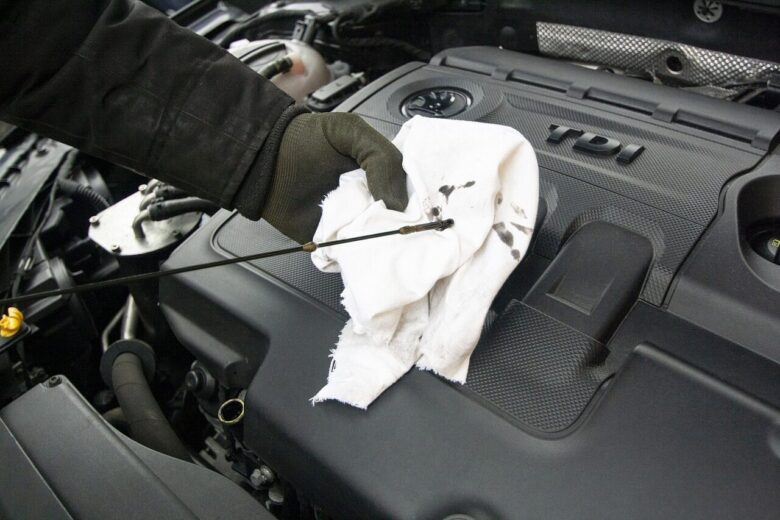
Check the oil on the dipstick:
- Light amber to medium brown: Normal for used oil
- Very dark brown or black: Heavy contamination; change soon
- Milky or frothy: Coolant contamination from a blown head gasket; urgent repair needed
- Thick and gritty: Severe contamination or sludge formation; change immediately
- Thin and runny with fuel smell: Fuel dilution from rich running or short trips; change soon
Engine Noise
Oil cushions metal-to-metal contact. When oil degrades, you may hear:
- Increased valve train noise: Tapping or clicking from the top of the engine, especially on cold startup
- Main bearing rumble: Deep knocking or rumbling that increases with engine load
- Rod knock: Metallic knocking that worsens when revving the engine
- General increased mechanical noise: The engine sounds louder and rougher than usual
Any new or worsening engine noise warrants immediate oil inspection and possibly a change. Noise indicates that lubrication is already compromised.
Oil Consumption
If your engine is burning or leaking oil and you are adding a quart every 1,000 miles, the oil is degrading faster because it is being topped off with fresh oil mixed with old. More importantly, oil consumption itself indicates engine wear or seal problems that need diagnosis.
Normal oil consumption is up to 1 quart per 2,000 to 3,000 miles for some engines. More frequent consumption indicates a problem. Check your manual for the manufacturer’s specification.
Dashboard Warning Lights
- Oil pressure light: This is an emergency. Low oil pressure means insufficient lubrication. Stop driving immediately and check oil level. If the level is correct and the light persists, the engine may have internal damage or a failing oil pump.
- Oil change reminder: A maintenance reminder based on mileage or time. Schedule service promptly but it is not an emergency.
- Check engine light: May indicate oil-related issues such as camshaft position sensor problems caused by sludge, or oil pressure sensor failure.
Performance Changes
Degraded oil increases internal friction, which can cause:
- Reduced fuel economy
- Sluggish acceleration
- Increased engine temperature
- Harder cold starts
These changes are subtle and develop gradually. If you notice a gradual decline in performance, check your oil condition and maintenance schedule.
How to Check Your Oil Properly
Many drivers check oil incorrectly, leading to false conclusions about level and condition. Here is the proper method:
Step 1: Prepare the Vehicle
- Park on level ground
- Turn off the engine and wait 5 to 10 minutes for oil to drain back to the pan
- Do not check immediately after driving — oil is distributed throughout the engine and the reading will be low
Step 2: Locate and Remove the Dipstick
- Find the dipstick handle, usually yellow or orange, near the front of the engine
- Pull it out completely and wipe it clean with a rag or paper towel
- Reinsert it fully until it seats, then pull it out again
Step 3: Read the Level
- Observe where the oil film ends on the dipstick
- It should be between the MIN and MAX marks, or within the crosshatched area
- At or below MIN: add oil immediately
- Above MAX: oil has been overfilled, which can cause foaming and seal damage
Step 4: Assess Condition
- Hold the dipstick to the light and observe color and clarity
- Rub a drop between your fingers — it should feel smooth, not gritty
- Smell the oil — it should smell like oil, not strongly of gasoline or coolant
Step 5: Document
- Note the date, mileage, level, and condition
- Track trends over time to spot consumption or degradation patterns
Choosing the Right Oil
Using the wrong oil is almost as damaging as using old oil. Your owner’s manual specifies:
Viscosity
Viscosity is the oil’s resistance to flow. It is expressed as a grade like 5W-30 or 0W-20. The first number indicates cold-start flow characteristics. The second number indicates operating temperature viscosity.
Use exactly what the manufacturer specifies. Modern engines are designed for specific viscosities to optimize fuel economy, bearing protection, and variable valve timing operation. Using a thicker oil than specified increases drag and reduces efficiency. Using a thinner oil may not provide adequate protection.
Oil Type
- Conventional: Refined petroleum oil. Least expensive but breaks down faster. Suitable for older engines and short change intervals.
- Synthetic blend: Mix of conventional and synthetic base stocks. Better protection than conventional at moderate cost.
- Full synthetic: Engineered base stocks with superior stability, temperature resistance, and cleanliness. Recommended for most modern engines, especially turbocharged or high-performance ones.
- High-mileage: Contains seal conditioners and additives for engines over 75,000 miles. Helps reduce leaks and consumption in worn engines.
Certifications
Look for API certification marks (the API donut symbol) and ILSAC ratings on the oil container. These ensure the oil meets minimum performance standards. Some manufacturers specify additional requirements such as dexos1 for General Motors or specific European ACEA ratings.
Common Oil Change Mistakes to Avoid
Overextending Intervals
Even with synthetic oil and oil life monitors, intervals have limits. If you drive 15,000 miles per year in severe conditions, waiting 15,000 miles between changes is risky. When in doubt, change earlier rather than later. The cost of an extra oil change is trivial compared to engine repair.
Using the Wrong Oil
Using 10W-30 in an engine designed for 0W-20 increases wear and reduces fuel economy. Using conventional oil in a turbocharged engine that requires synthetic can cause turbocharger failure. Follow the manufacturer’s specifications exactly.
Ignoring the Oil Filter
The filter traps contaminants. A clogged filter bypasses unfiltered oil to the engine, defeating the purpose. Always replace the filter with every oil change. Use a quality filter that matches the manufacturer’s specifications for flow rate and filtration capacity.
Overfilling
Too much oil causes the crankshaft to whip air into the oil, creating foam that cannot lubricate properly. It also increases pressure on seals and can cause leaks. Fill to the MAX mark, not beyond.
Neglecting the Oil Change Reminder
Many drivers ignore maintenance reminders because the car seems fine. Oil degradation is not always obvious until damage has occurred. Treat reminders as preventive maintenance, not optional suggestions.
DIY vs. Professional Oil Changes
DIY Oil Changes
Changing your own oil is one of the most accessible DIY maintenance tasks. It requires:
- Basic hand tools: wrench, oil filter wrench, drain pan, funnel
- Correct oil and filter for your vehicle
- A safe place to work with level ground
- Proper disposal method for used oil (most auto parts stores accept it free)
Cost savings are significant. DIY oil change costs $30 to $60 in parts versus $70 to $150 at a shop. Over five years, doing it yourself saves $500 to $1,000.
Professional Oil Changes
Shops offer convenience, speed, and multi-point inspections. They also dispose of oil properly and may spot other maintenance needs. The trade-off is higher cost and the risk of upselling unnecessary services.
If you use a shop, specify the exact oil type and filter you want. Do not accept generic oil in a high-performance or turbocharged engine. Verify they used the correct amount by checking the dipstick before leaving.
Bottom Line
Knowing when your car needs an oil change is not about following a rigid schedule or waiting for a warning light. It is about understanding your specific vehicle, your driving conditions, and the physical signs that oil is degrading.
Follow the manufacturer’s recommendations as your baseline. Check your oil monthly for level and condition. Listen for new engine noises. Watch for consumption trends. And when any indicator suggests the oil is failing, change it promptly.
The cost of an oil change is $30 to $150. The cost of engine damage from neglected oil is $3,000 to $10,000 or more. The math is simple, and the choice is yours.
Related Reading
Keep your entire car running smoothly with our monthly maintenance checklist: Car Maintenance Checklist for Beginners: What to Inspect Every Month.
Disclaimer: This article is for informational purposes only. Always follow your vehicle manufacturer’s specifications for oil type, viscosity, and change intervals. Oriola Car Insights is not responsible for engine damage resulting from oil changes performed based on this content.

The Oriola Cars Editorial Team creates and reviews practical automotive content about vehicle ownership, maintenance, used-car buying, safety, insurance and everyday driving costs.